

Create Elementary School Student ID Card
Make a cheerful ID card for young learners, with a rainbow photo frame, friendly rounded lettering and clouds, stars and flowers. Add the school, teacher, class, grade, bus number and a parent contact with an optional note about allergies. Download a two-sided wallet-size PDF in minutes.
Choose from four colour palettes. Tap Load sample data to see a finished card.
Fill in the information below
Other Similar Templates
Some other templates similar to this one are also available here. If you would like to create your ID CARD using one of these templates, visit the following.
An ID card that feels like a treat, not a rule
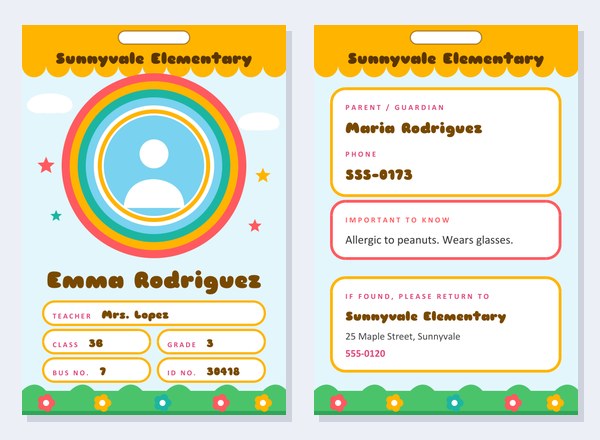
For a six-year-old, a school ID card is a grown-up object: it goes on a lanyard, it has a photo, and it says “I belong here.” That is exactly why it should look friendly. This template wraps the necessary facts in a world children recognise: a sunny sky, a rainbow ring around the photo, fluffy clouds, twinkling stars and a strip of flower-dotted grass at the bottom. The lettering is soft and rounded, the details sit in tidy rounded “pills”, and every colour is bright enough to be seen from across the playground.
The front shows the school name, a round photo, the child’s name, teacher, class, grade, bus number and ID number. The back is built for the adults: the parent or guardian’s name and phone number, a space for important health notes, and a clear “if found, please return to” panel with the school’s address and telephone.
Where it helps
- Field trips: a card on a lanyard helps the teacher and volunteer parents recognise their group and find a contact number fast.
- School bus and after-care: drivers and helpers can see the child’s name, bus number and class at a glance.
- First-week nerves: children who are new to a school often feel calmer when they have a card of their own.
- Library and lunch: a printed number makes it quick to check out books or log lunch choices.
- Holiday clubs and day camps: organisers can use the same design with a different school name, colour and class.
- Classroom role play: teachers can print cards for a “Community Helpers” unit or a pretend school.
Four bright palettes
- Sunny: a sunshine-yellow band with a coral rainbow, the cheeriest of the four.
- Ocean: a blue band with sunny yellow touches, calm and clear.
- Berry: a raspberry band with violet accents, a favourite for many children.
- Garden: a leafy green band with orange details, lively and fresh.
Choose one palette for the whole school, or give each class its own colour so that teachers and bus helpers can sort children quickly.
Filling in the front
- School name. It runs along the coloured band at the top. If you upload a logo, it appears in a small white circle at the left.
- Student name. The name is printed large. A short name gets bigger letters; a long one shrinks to fit.
- Teacher, class, grade, bus and ID. Each appears in its own rounded pill. Any pill you leave blank is simply left out, so a school without bus numbers still gets a tidy card.
- Photo. It is cropped to a circle and placed inside the rainbow rings. A cartoon silhouette holds the place until you add a picture.
Next to each caption is a small pencil. Click it to rename the printed word: “Teacher” can become “Homeroom”, “Class” can become “Room”, “Bus No.” can become “Route”, and so on.
Filling in the back
The back carries three rounded panels. The first holds the parent or guardian’s name and telephone number. The second, “Important to know”, is optional and has room for a short note such as an allergy, a medical condition or the fact that a child wears glasses. The third shows the school’s name, address and phone number so that anyone who finds a lost card knows where to take it.
A word of care: a card can be dropped, lent or left on a table. Keep the notes short, factual and limited to what a stranger needs in an emergency. Do not print a home address, a full birth date or any sensitive family information. Schools should also follow their local data-protection rules before putting a child’s name, photograph and contact details on a card.
Making a set for a whole class
- Create the first card and check the spelling of the school name and teacher.
- Download the PDF and print a test copy on plain paper.
- Change the child’s name, ID, photo and parent details, then create the next card. The school, teacher, class and colours can stay the same.
- Print everything on card stock, cut out the cards and punch a hole at the printed oval.
- Thread each card on a safe breakaway lanyard or slide it into a clip-on sleeve.
Printing and durability
Each page measures 2.63 by 3.88 inches, the usual card size for lanyard sleeves. Print on white card stock of 200 to 250 gsm for sturdy cards that survive the playground. A laminating pouch protects the card from spills and sticky fingers; choose a matte finish if the room is bright, because glossy lamination can reflect light. Round the corners with a punch so that they are gentle on small hands.
Fun ways to use the card in class
- Practise reading by asking children to find their name, teacher and class on the card.
- Use the bus number for early maths: “Whose number is bigger?”
- Let children decorate a blank copy with stickers before the real one is issued.
- Teach road and school safety by explaining why the card should stay inside a coat and not be shared.
Questions people ask
Is this suitable for a nursery or kindergarten?
Yes. Leave out the grade and class and use the teacher and ID pills only.
Can I leave the medical note empty?
Yes. The panel is left out and the back simply shows the other two panels.
Does the card have a barcode?
No, this version favours a clean, child-friendly look. The ID number is printed in words and digits.
Can parents make the card themselves?
Yes, for example for a holiday club, a play-date or a school trip. Check with the school if it requires its own official card.
Does it cost anything?
No, it is free to create and download.